.jpg)
Configuration, “to form from or after,” derives from the Latin com -, meaning “with” or “together,” and figurare, “to form.” It also means “a relative arrangement of parts or elements.”
Configuration management therefore refers to managing a relative arrangement of parts or elements. It’s as simple as that. The concept of relative arrangement is important.
The term configuration refers to a complete description of the functional and physical characteristics of the product. In this sense, “product” is taken to mean any system or subset thereof.
Configuration Management has to do with the characteristics of products, and we should add that it has to do with the keeping of accurate records of these characteristics. To explain the necessity for keeping these records, an example is required.
The concept of configuration management was originally identified by the United States Air Force for the Department of Defence in the early 1960s.
It arose from problems encountered when defence contractors were unable to build consistent quality items for delivery to the Department of Defence. In essence, the second unit was not quite like the first and the third was not like either the second or the first. Performance characteristics and even the aesthetic characteristics were often very different.
The problem became even greater when the contract was terminated due to the inconsistent quality, and the follow-on contractor had to reverse engineer the best performing item in order to produce a working product.
In an attempt to solve this problem, the concept of Configuration Management was born. Contrary to popular belief, the concept of Configuration Management was part of a greater whole which included management of the complete product lifecycle. This incorporated elements of testing and integration and much more.
As a starting point, the configuration of an aircraft is illustrated.
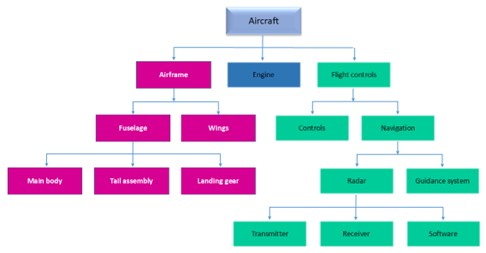
We can see that the aircraft consists of several independent systems that together constitute an aircraft.
To keep track of all the components installed on the aircraft, some system of record keeping must be designed. It is this system that we call the Configuration Management System.
The information carried within the system allows personnel to manufacture new products and also to maintain existing products.
It further allows personnel to make modifications to existing and new products and keep track of those modifications. This is a special part of Configuration Management called Change Management.
When a product is built for a customer, the supplier needs to keep a record of the state of the product as supplied. This is another special function of Configuration Management which is called Release Management.
Release Management is particularly important in the modern hardware and software environment because changes in technology happen so quickly. It is not unheard of for a product to be supplied and within days require a software upgrade. If the supplier did not know which customers had been upgraded, there could be serious problems in managing the service and maintenance effort in the field.
Similarly, the supplier should know which version of upgrade the customer has – without this information the supplier would simply have to keep upgrading no matter what the state of the released product. Keeping track of the upgrades is another specialist area of the Configuration Management environment.
There are five important elements of Configuration Management:
Managing a small product or small range of products can be done manually. However, as soon as we begin to encounter products with several components, or several products with multiple components, we need the assistance of Configuration Management software.
There are many different software packages that are used to manage configurations. These range from elementary spreadsheets through to seriously large software applications that span hundreds of users and many thousands of components.
These large systems are integrated with the organisations purchasing system, its sales system, and its financial system and with the various technical departments within the organisation.
If any customers product changes, the system will record that information. If the supplier of a part changes, the system will keep a record of it. If the characteristic of a part changes, then the system will keep a record of that and be able to inform the administrator of which customers have the related product. It will also be able to inform the customers that their product needs to be upgraded to the latest version of the product by having that small component changed.
Example:
Source: Toyota Motors
2015 Toyota Camry XSE
Toyota Motor is recalling more than 110,000 vehicles, the automaker said on Wednesday.
The company announced that it will conduct a safety recall of approximately 2,500 2012–2014 RAV4 EV vehicles, and approximately 110,000 2015 Camry, Camry Hybrid, Highlander, Highlander Hybrid, and 2014-2015 RAV4 cars.
Owners of the involved vehicles will receive a notification in the mail, Toyota said.
For the recall-involved RAV4 EV vehicles, components in the Electric Vehicle Traction Motor Assembly (part of the propulsion system) "may cause the vehicle to shift to 'neutral' due to a software issue," Toyota said.
"If the vehicle shifts to 'neutral', this will result in a complete loss of drive power, which can increase the risk of a crash," the recall notice stated.
For the involved Camry, Camry Hybrid, Highlander, Highlander Hybrid and RAV 4 cars, Toyota's recall said that "a circuit board for the electric power steering (EPS) may have been damaged during its manufacturing process."
Without a Configuration Management System, Toyota would not know which vehicles are affected, where the vehicles were sold and who the customers were. They would not be able to despatch the correct number of replacement units to the various regions and would also not be able to keep records of which vehicles have been upgraded.
Configuration Management is covered extensively in our Configuration Management Module.